Skopje 2014: A City That Built Its Own History
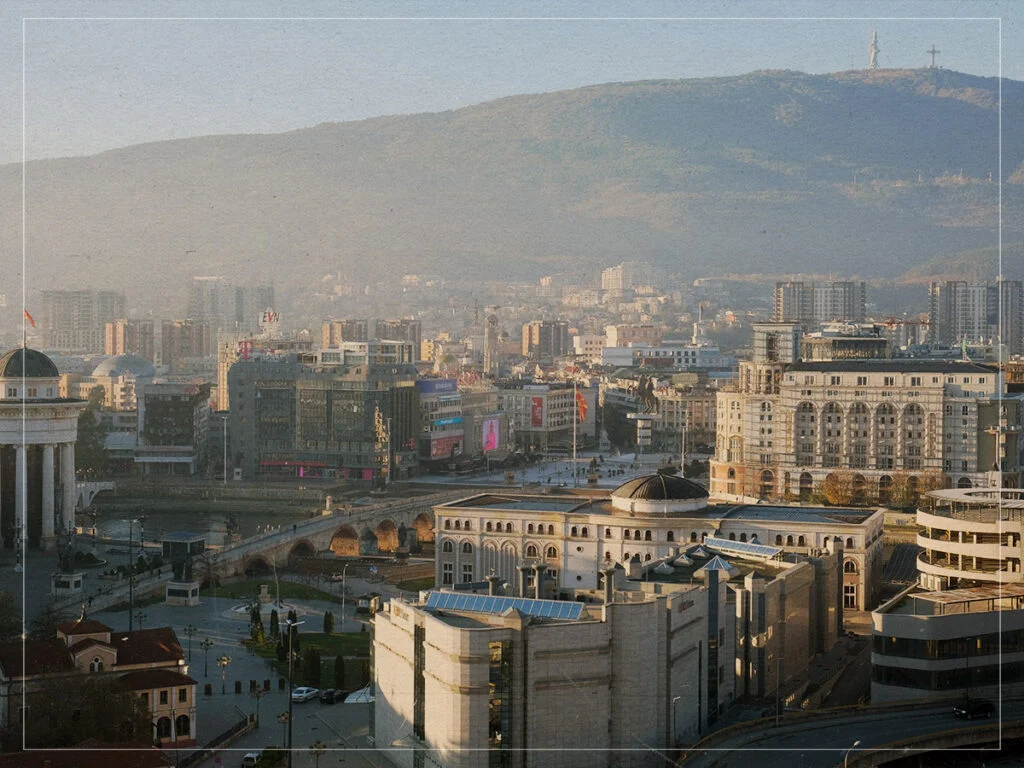
Walk through central Skopje, capital of North Macedonia, and you'll pass marble colonnades along the Vardar River, a triumphal arch spanning a roadway, bronze warriors and kings on nearly every corner, and an equestrian statue of Alexander the Great. It reads like an ancient capital. According to Far Out Magazine, almost none of it is more than twenty years old — all of it dates from a 2010 urban redevelopment project called Skopje 2014.
Skopje sits at the center of the Balkans and has passed through Roman, Byzantine, Bulgarian, Serbian, Ottoman and Habsburg rule, then became part of the Kingdom of Yugoslavia and later socialist Yugoslavia in the 20th century. It's also the birthplace of Mother Teresa.
1963 earthquake and Kenzo Tange's modernist rebuild
On July 26, 1963, a magnitude 6.0 earthquake hit Skopje, destroying roughly 80% of the city's buildings within 20 seconds, killing more than 1,000 people and leaving about 150,000 homeless.
International funding and architects poured in afterward, and Japanese architect Kenzo Tange won the competition to redesign the city center. Over the following decade he rebuilt it by blending Eastern European brutalist concrete forms with traditional Japanese spatial concepts, producing a distinctive modernist district.
Skopje 2014: over 130 structures, nearly 200 statues
The Skopje 2014 plan, announced in 2010, originally called for around 40 new or renovated monuments and 20 buildings. What actually got built went far beyond that scope: within a few years, more than 130 structures were either newly built or given neoclassical facades bolted onto existing buildings — including new bridges — while socialist-era buildings were wrapped in decorative concrete cladding.
Nearly 200 statues went up across the city center, depicting historical figures and national legends. Tange's clean modernist streetscape was buried under dense Baroque-style ornamentation and faux-antique elements.
Budget disputes and a national narrative
Cost has been another flashpoint. The project's original budget was around €80 million; some estimates put the final spend at close to €500 million. No police prosecution has resulted from the case, though the Far Out Magazine writer, visiting in person, reported hearing locals discuss corruption rumors from that period.
North Macedonia only became independent from Yugoslavia in 1991 and is a young state. Its national hero, Alexander the Great, overlaps heavily with Greek history, while its more recent memory is tied up with Yugoslavia. Skopje 2014 emerged from that historical position — an attempt to give the city a manufactured, visible antiquity.